ServiceNow Otto, Explained Without the Brochure
If you’ve been in a ServiceNow meeting lately, you’ve probably heard Now Assist, Otto, Moveworks, Copilot and Claude all in the same ten minutes. Everyone nods. I’m not sure half the room could draw you a picture of what sits where. Everyone knows they should be doing something with AI, but I don’t think many people know where to actually start, and that’s ok.
I’ve worked in and around ServiceNow since 2016, and the names have moved fast enough this year that I wanted to sort it out properly. It also comes up on calls with customers constantly, so I’ve had to explain it quite a few times over the past couple months. So here’s the map I drew for myself, using only what ServiceNow and the other vendors say publicly. No brochure language, I promise :)
First, the tiers
Since Q2 2026, ServiceNow sells most of its product lines in three AI-native tiers: Foundation, Advanced, and Prime. The big change is that the AI moved into the tier itself, instead of being something you bolt on later. We used to add the AI functionality through updates to Pro or Pro-Plus add-ons etc. Now, AI is included on all the SKUs, which is great, but you need to manage the consumption of those AI features instead.
The names, one line each
Here’s the cast. Some of these are old friends with new jobs.
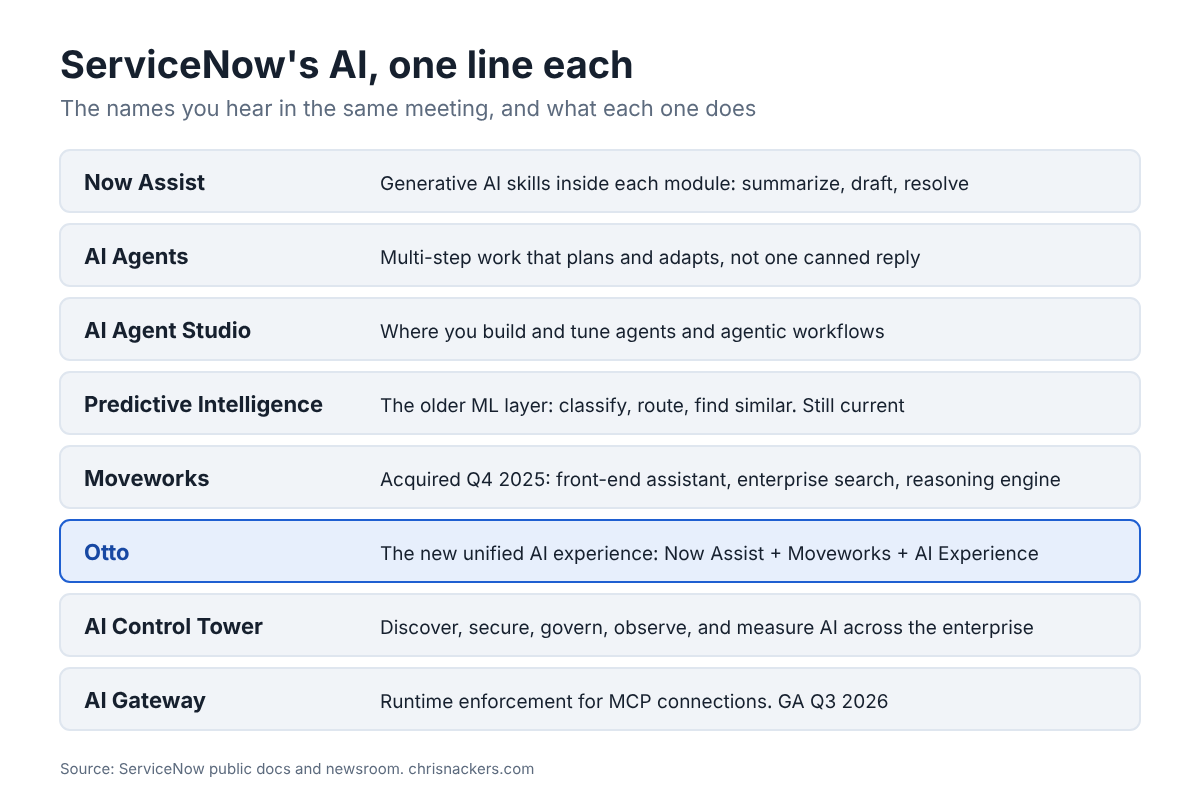
- Now Assist: The generative AI built into each module. Summarize a case, draft a reply, help resolve an incident.
- AI Agents: Multi-step work that plans and adapts, instead of firing one canned response.
- AI Agent Studio: Where you build and tune those agents.
- Predictive Intelligence: The older machine-learning layer for classification, routing and finding similar records. Still current, still useful, and nobody talks about it anymore.
- Moveworks: The employee assistant platform ServiceNow finished acquiring in Q4 of 2025. A conversational front door, enterprise search, and a reasoning engine.
- AI Control Tower: Governance for AI, both ServiceNow’s and everyone else’s. More on that below.
- AI Gateway: Runtime enforcement for MCP connections (MCP is the open protocol AI tools use to talk to other systems). Generally available since Q3 2026.
So what is Otto?
This is the one that’s confusing people right now, so let’s take it slow.
In Q2 of 2026, ServiceNow announced Otto as its unified AI experience. It brings together three things that used to be separate: Now Assist, Moveworks, and AI Experience. It showed up first in EmployeeWorks and AI Control Tower, and ServiceNow says it’ll extend to all products over the next year.
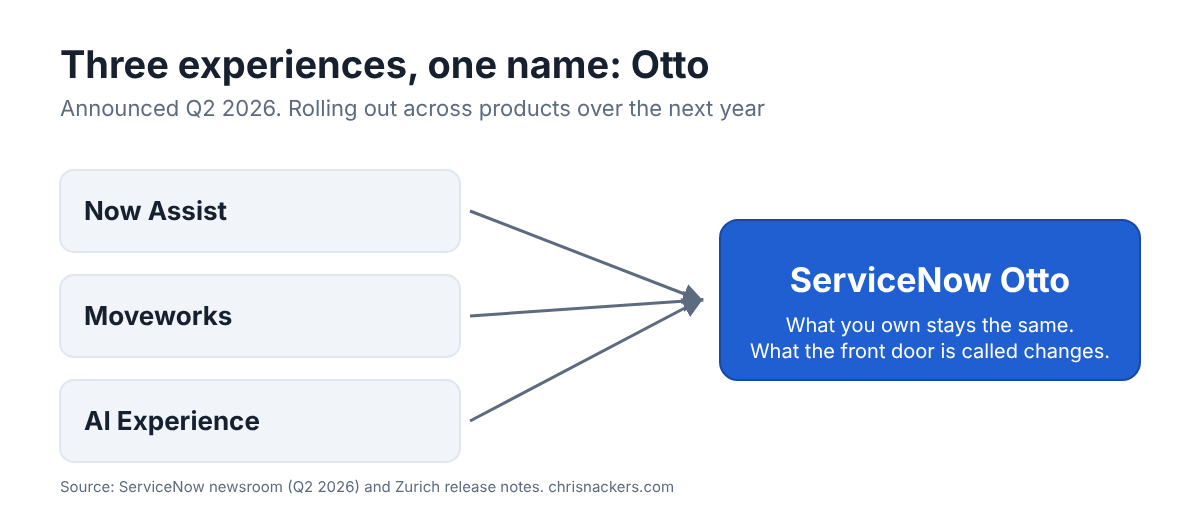
A few things worth knowing:
- It’s not just a rebrand. ServiceNow’s own developer advocates say so, and the merge of three assistants into one front door backs that up.
- Your entitlements don’t change. The Zurich release notes say so directly. What you own stays the same. What the front door is called changes.
- It goes where people already work. Per ServiceNow’s developer advocate blog, Otto runs natively in Microsoft Teams, Slack, and Google Chat.
- The names are still moving. Some products already say “ServiceNow Otto for…” in the release notes, others still say Now Assist. Expect both for a while. They are constantly changing and it’s going to take a little while for the documentation to get fully updated.
SIDE NOTE: Did you know there is a Git repo of the ServiceNow docs site? It’s SUPER helpful to have as a resource for your AI of choice.
If someone asks you “should we buy Otto?”, the honest answer is usually “you might already have it if you are on the newer “AI-forward” SKUs, let’s look.”
Where the outside AI fits
This is the part I see trip people up the most. Your company probably already has Copilot, Claude, or both. Does ServiceNow’s AI compete with them?
I don’t think so. ServiceNow’s AI is built to live inside ServiceNow’s tables and workflows. Copilot and Claude are built to live wherever the person already works: Word, Outlook, Teams, a chat window, a code editor. That’s AI in different places, not paying three times for the same thing.
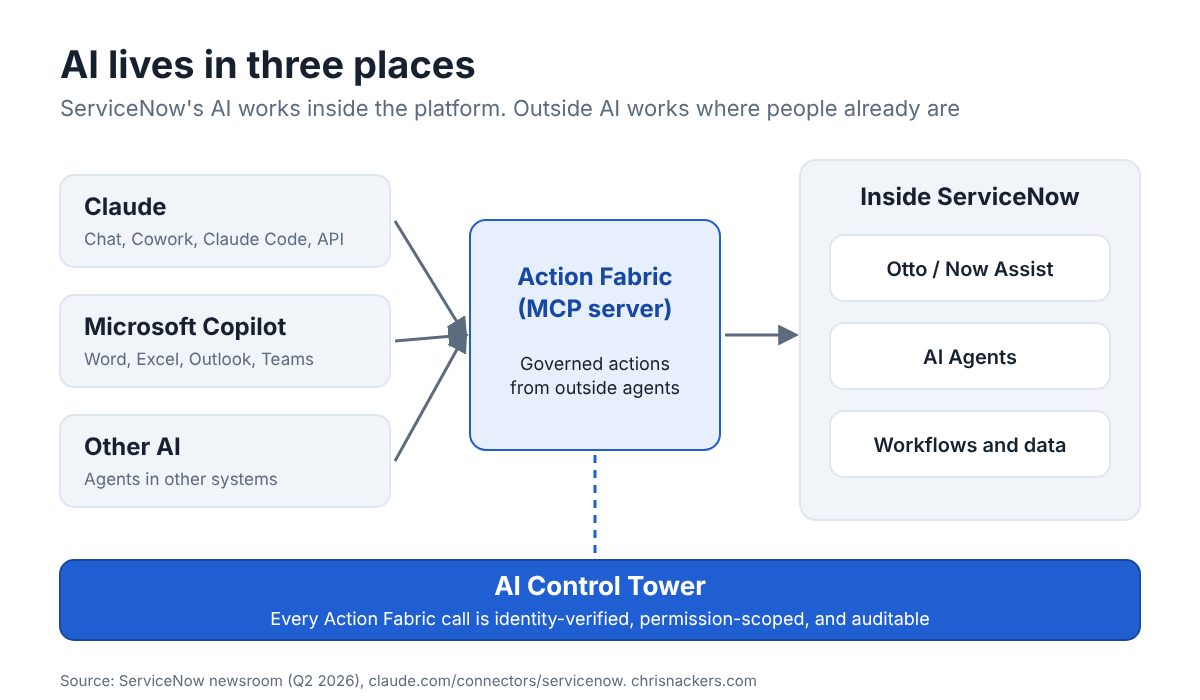
The bridge between them is Action Fabric, announced in Q2 of 2026. It’s a generally available MCP server that lets outside AI agents take governed actions inside ServiceNow. ServiceNow says Anthropic was first in line (Claude Cowork), and it called out Copilot as an example too. Anthropic has a ServiceNow connector page of its own that works in the Claude apps, Claude Code, and the Claude API.
The part I like: every action an outside agent takes through Action Fabric runs through AI Control Tower, so it’s identity-verified, permission-scoped, and auditable.
Keep in mind: Action Fabric governs what an outside agent can DO once it’s acting. Seeing that the agent exists in the first place is a different job, and that’s Control Tower’s (ideally).
AI Control Tower, in plain terms
ServiceNow describes Control Tower with five verbs: discover, secure, govern, observe, and measure. Here’s how I’d translate them.
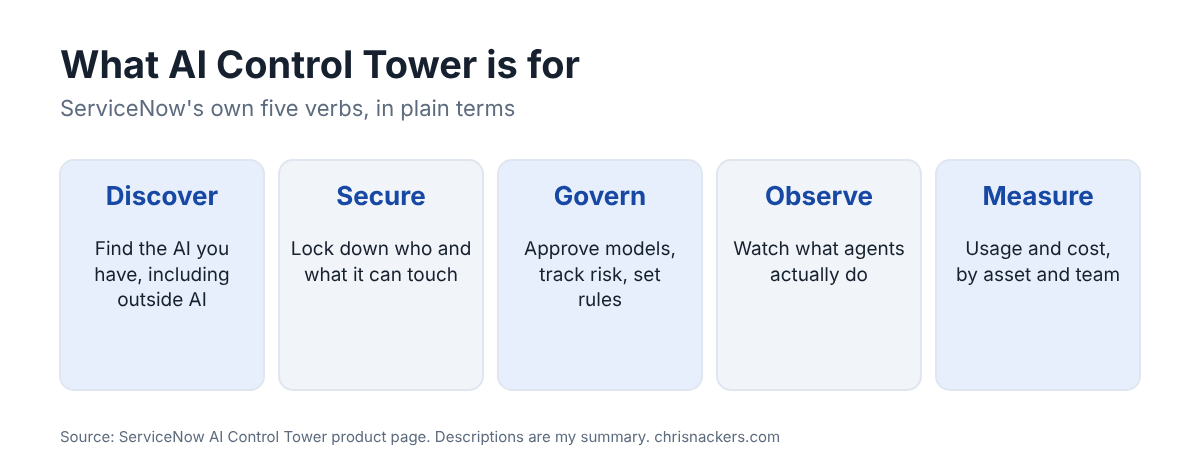
- Discover: find the AI you have. There are connectors for the big cloud AI platforms, and a new connector for Anthropic landed in the Q3 2026 release.
- Secure: limit who and what it can touch.
- Govern: approve models, track risk, set the rules.
- Observe: watch what agents actually do.
- Measure: usage and cost by asset, user and department, including token use for outside providers like Anthropic.
One honest note: coverage isn’t even. ServiceNow’s own AI gets the full treatment. Outside AI is seen as well as its connector allows, and anything without a connector gets registered by hand. That’s not a knock, it’s just how it works today. Plan for it. It’ll likely change in the future, but as I’m writing this in Q4 2026, that’s the current state as best as I can summarize it.
Model choice, briefly
You’re not locked into one model. Admins can choose which LLM powers Now Assist skills, by instance, by group of skills, or skill by skill. ServiceNow’s community documentation lists its own Now LLM Service, Azure OpenAI, Google Gemini, and Anthropic Claude through Amazon Bedrock. The supported versions move faster than any blog post, so check the current docs before you pick one.
Where I’d start
This part is my opinion, not ServiceNow’s.
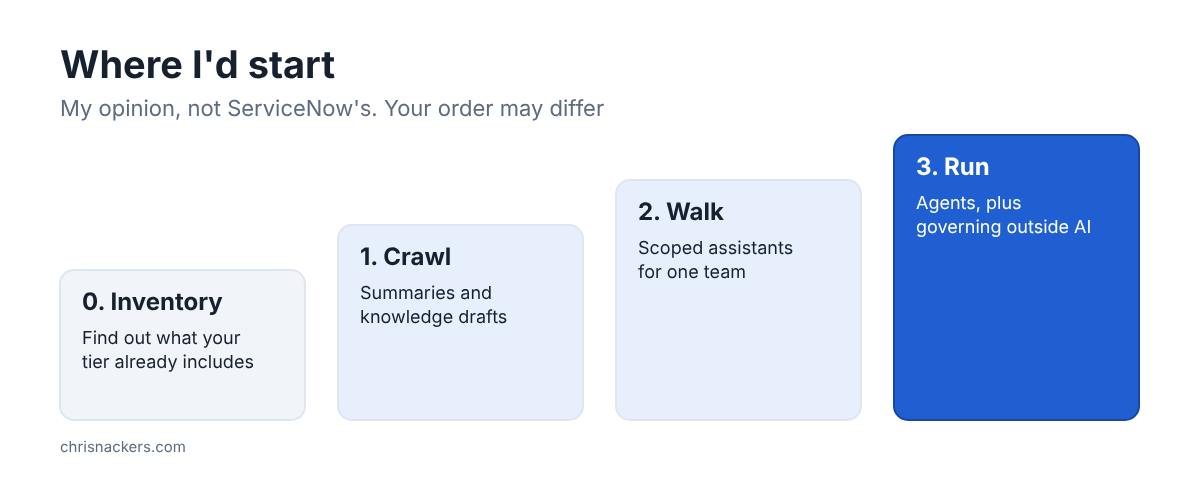
- Inventory first. Find out what your current licensing already includes before buying anything new. You’d be surprised, you might have more than you think. Talk to your ServiceNow sales rep, talk to your partner, etc.
- Crawl: Summaries and knowledge drafts. Low risk, quick wins, people feel it right away.
- Walk: A scoped assistant for one team that has a clear, repeatable job.
- Run: Agents doing multi-step work, and governance for the outside AI your people are already using.
The mistake I’d avoid is starting at step 4 because the demo looked cool. The demo always looks cool. You also need to look at the usage and manage the tokens or in ServiceNow land “assists” to see what the total cost of ownership (TCO) might be. Likely you’ll find ways to make skills and tasks more efficient so they don’t cost as much to run/execute.
Side-bar, which LLM should I use? “Y” vendor tells me theirs is the best
Every vendor is going to be pushing their AI and also likely saying it will integrate with other systems etc, that’s the “game” of the current-state (IMO). Get as much as you can into a single AI system, consume tokens and generate revenue for said business. That’s just where we are, at least for now. And let’s be honest, the AIs are getting really good, like insanely good at this point, but they do each have their own areas they excel in, so finding those can be the tricky part.
Copilot has amazing integrations into the Microsoft ecosystem, and if you want some light-hearted humor on a slow day, or when you just need something to laugh at, ask Copilot to summarize your week in the style of a comedy roast. I promise, it’s hilarious sometimes. However, at least personally I wouldn’t pick Copilot for deep reasoning or thinking, I’ve found other LLMs to be better at that.
Claude is my main go-to, for personal and work. I’ve used it a ton, it just keeps getting better and the reasoning and logic aligns with how I personally work in my day job and personal style and side-hustles.
ChatGPT, I used to use quite a bit, and it’s pretty good at generating MEMEs :) But I personally abandoned it when Claude took over for me personally, but I still see some people that swear by it.
Point being, they are all pretty good and the more you use them, work with them, learn from them, and TEACH them; you and they will get better working together as a team.
The short version
- Otto is the new front door. Your entitlements don’t change with the renaming and rebranding.
- ServiceNow’s AI and your outside AI aren’t competitors. They work in different places. For the most part…
- Action Fabric is the bridge, and Control Tower watches the bridge.
- Most of the mainstream AIs are quite good, you can’t really go wrong, just start!
All of this is moving monthly, so I’ll update this post as best I can when the names shuffle again (and they will). I promise I have a huge backlog of posts on both ServiceNow topics and general AI stuff.
Hope this helps someone else make sense of their next AI meeting. Let me know your thoughts!
-Chris